Workshop journal
The structural restoration of a 1945 Marcelo Barbero flamenco guitar built with Brazilian rosewood back and sides.
This 1945 Marcelo Barbero had been stored away for around thirty years when it arrived at my workshop.
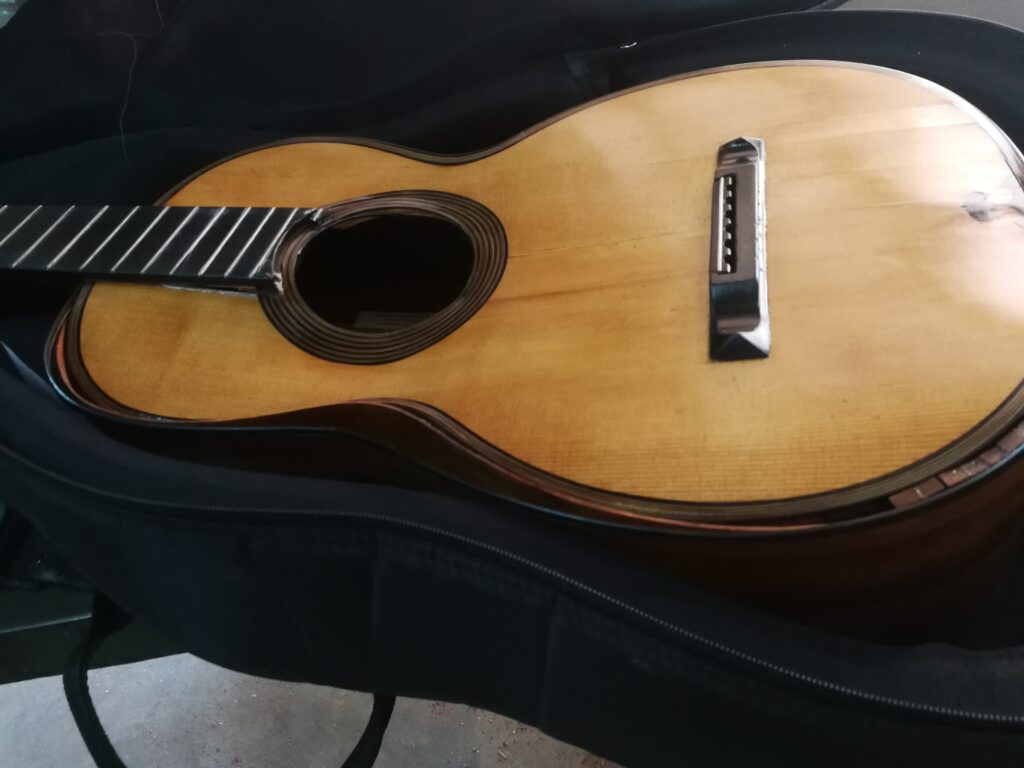
The guitar was almost completely loose inside. Nearly all the braces had become detached, the back was cracked, the bridge had lifted and several decorative elements had also come loose.
This was not simply a matter of regluing an isolated part. The instrument had to be opened, its internal structure restored and the original components returned to the positions in which they were meant to work.
The most difficult problem emerged later, when I tried to refit the back. Once the braces had been adjusted and reglued, the back was approximately two millimetres short of closing correctly over the edge of the body.
Restoring the Marcelo Barbero’s original braces
When examining the interior, simply passing a thin blade beneath the braces was enough to confirm that they had come unglued.
Marcelo Barbero built this guitar in 1945, at a time when the availability of materials and adhesives was affected by the post-war period. I have encountered similar glue-joint problems in some of his other guitars from this early period.
In this case, the braces were still present and could be preserved. I removed, cleaned and refitted them one by one. Wherever they had lost height or contact, the mating surfaces had to be adjusted so that they would once again seat correctly against the back.
The aim was not to replace them with a new system, but to restore the guitar’s original structure.
I also closed the crack in the back and refitted the bridge and decorative elements that had arrived detached.
The instrument’s initial condition, removal of the back and restoration of the original braces.
A two-millimetre discrepancy in the guitar body
After repairing the braces and preparing the back for refitting, a geometrical problem became apparent.
At the widest part of the body, the back was approximately two millimetres short of reaching the edge of the sides correctly.
I could have added material to the braces to make up the difference, but the result would have remained visible inside the instrument. The restoration would have worked structurally, but it would have introduced a modification foreign to the original construction.
I decided to correct the discrepancy at the tail of the guitar.
I detached the end block, removed the back’s centre strip and reduced the internal volume of the body very slightly—by around one millimetre. I then refitted the same block and adjusted the back again.
The correction was minimal, but it restored the geometry required for the original components to meet once again in their proper positions.
Adjusting the tail and the back to restore the body’s original geometry.
Restoring a historic Spanish guitar without transforming it
When a historic Spanish guitar is opened, more than its principal components must be preserved.
The back must be removed without breaking it, the label retained, the bindings and purflings respected, reusable elements recovered, and the body closed again at precisely the same point.
The value of a good restoration does not lie in leaving a visible signature on the instrument. It lies in coming as close as possible to its original construction.
Almost the entire internal structure of this Marcelo Barbero had become detached, but the parts were still there. The restoration consisted of recovering them, not replacing them with a new interpretation of the guitar.
Restoration of the internal structure and the completed guitar’s Brazilian rosewood back.
A 1945 Marcelo Barbero with Brazilian rosewood back and sides
Marcelo Barbero built this flamenco guitar with a spruce soundboard and Brazilian rosewood back and sides.
It has a scale length of 665 millimetres—long for a Spanish guitar—yet retains a lightweight construction: the complete instrument weighs 1,350 grams.
After the braces were restored, the back closed and the body stabilised, the guitar had an action of 2.5 millimetres at the 12th fret and a string height of 10 millimetres above the soundboard at the saddle.
The nut is 50 millimetres wide. The spacing between the first and sixth strings is 45 millimetres at the nut and 58 millimetres at the saddle.
It has geared machine heads and a French-polished shellac finish.
- Maker and year
- Marcelo Barbero, 1945
- Type
- Flamenco guitar
- Soundboard
- Spruce
- Back and sides
- Brazilian rosewood
- Scale length
- 665 mm
- Nut
- 50 mm wide; 45 mm between the first and sixth strings
- Saddle
- 58 mm between the first and sixth strings
- String heights
- 2.5 mm at the 12th fret; 10 mm above the soundboard at the saddle
- Machine heads
- Geared
- Finish
- French-polished shellac
- Weight
- 1,350 g
Pedro Javier González plays the 1945 Marcelo Barbero
After the restoration, the guitar can be heard in a recording by Pedro Javier González.
The video shows the instrument after it had been closed and captures its response following the restoration of the original braces, repair of the crack in the back and recovery of the body geometry.
Ali Arango plays the 1945 Marcelo Barbero
The same guitar appears in a second recording, played by Ali Arango.
The two videos make it possible to hear this Marcelo Barbero in the hands of different guitarists after the restoration was completed.
When this guitar arrived at the workshop, almost all the braces were detached. The back was cracked, the bridge and several decorative elements were loose, and the body had not been working correctly for decades.
It was a complex restoration, although the finished result had to suggest precisely the opposite: a 1945 Marcelo Barbero that preserved its construction without displaying the work carried out on it.
Domingo Esteso 1924: Cracks, Cypress and a Side Fitted Backwards
José Ramírez 1933: The Guitar Hidden Beneath a Layer of Black Paint
Manuel Ramírez 1915: Birdseye Maple and New Brass Frets
Marcelo Barbero 1949: Saving a Soundboard Just 0.5 Millimetres Thick
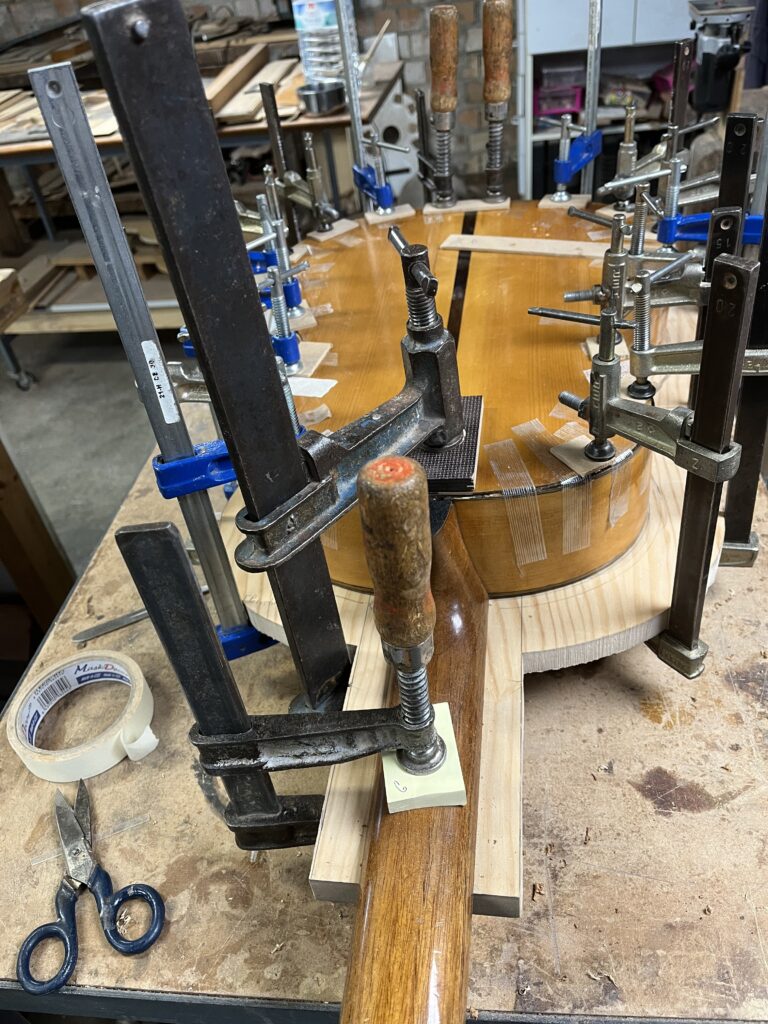
Santos Hernández 1933: Repairing the Sides from Inside the Guitar
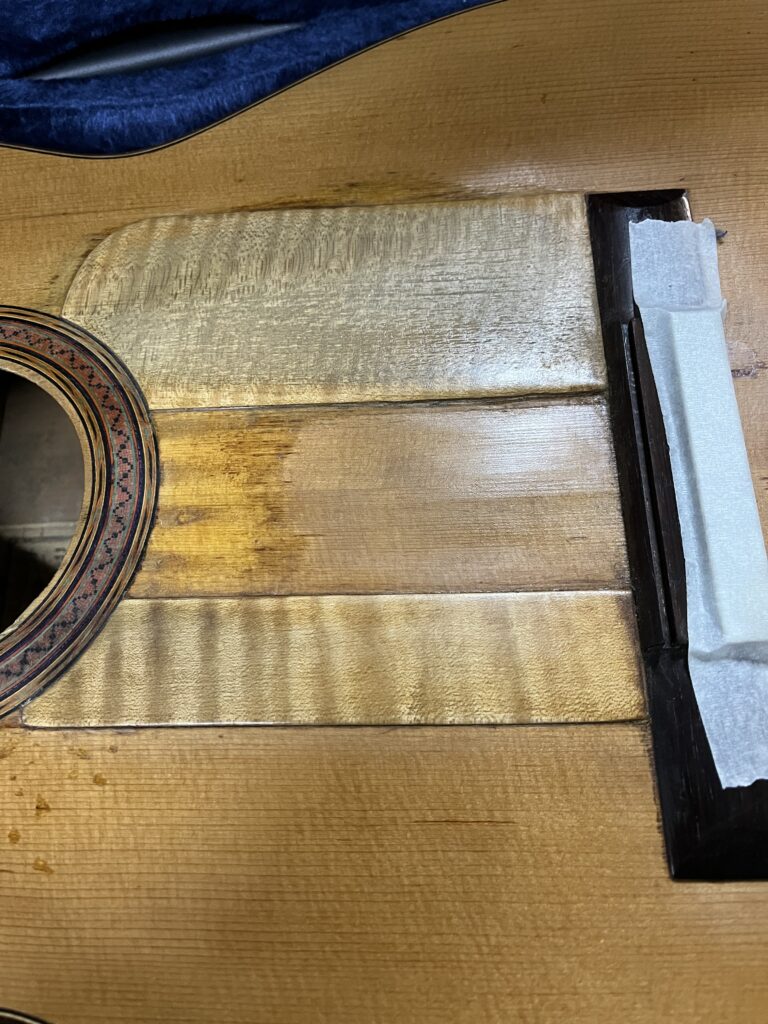
Santos Hernández, 1924: Opening a Spanish Guitar After One Hundred Years
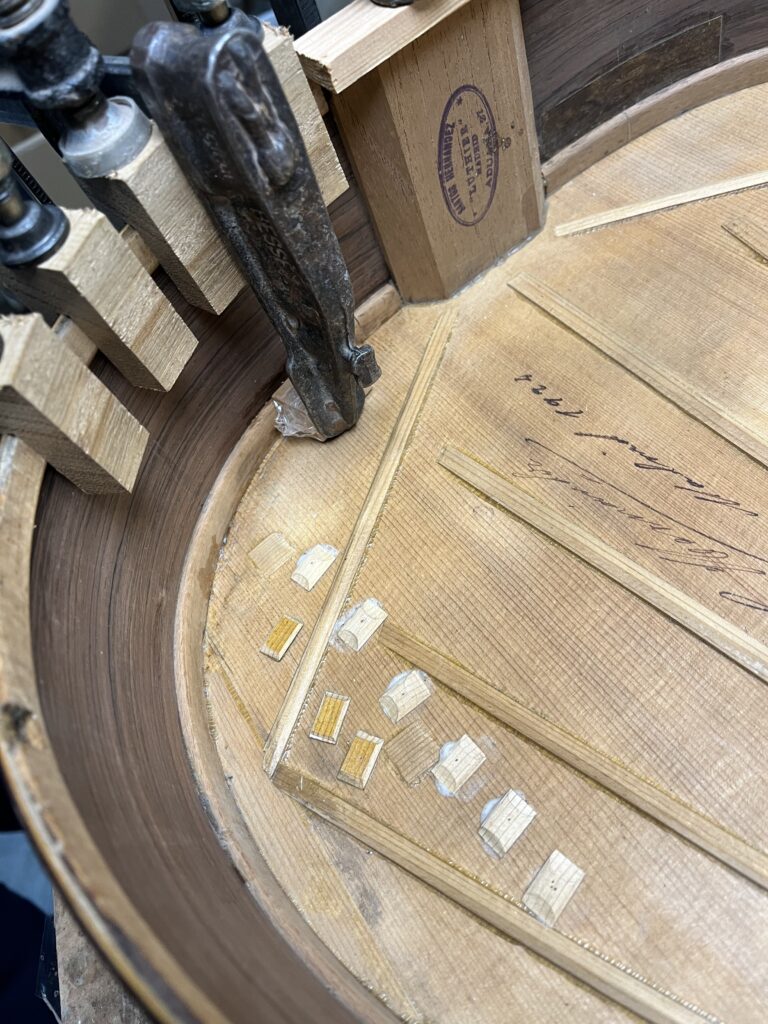
Pablo del Hierro 1856: Rebuilding a Spanish Guitar Piece by Piece