Workshop journal
This guitar by Pablo del Hierro, built in 1856, arrived at the workshop in a state of complete structural collapse.
Its owner kept it in a room designed to maintain stable temperature and humidity. While he was away, the system stopped working properly and the room became extremely humid.
The hide glue softened and, with the strings still under tension, the guitar gave way.
The soundboard bowed upwards, the sides came loose, the joints opened, and much of the structure shifted out of position. Remarkably, the wood bent without splitting.
The instrument had to be completely disassembled and rebuilt while preserving everything that could still be saved.
Complete disassembly of an 1856 Spanish guitar
The soundboard had separated from the edges and was badly deformed around the soundhole. The sides had also come loose, and the body had lost its shape.
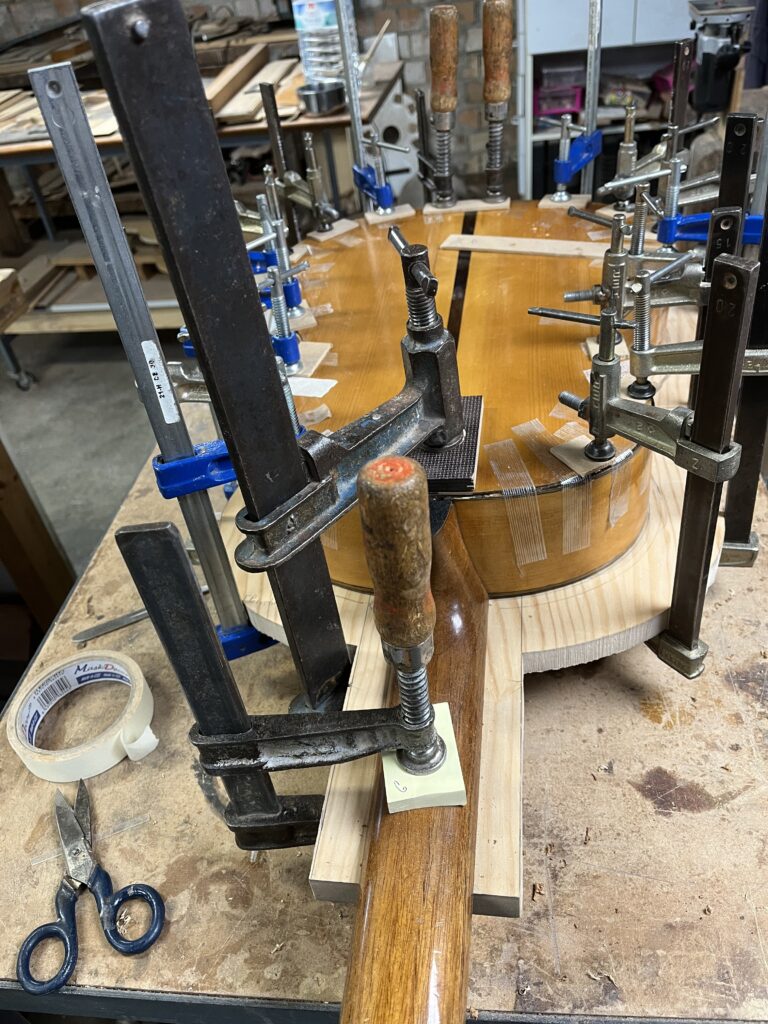
I gradually disassembled the instrument so that I could clean the joints, straighten the components, and recover its original geometry.
The soundboard could be returned to its position without having fractured. After such severe deformation, the fact that the wood retained this capacity to recover was one of the most striking aspects of the restoration.
The soundhole purfling had come out of its channel. Refitting it was especially difficult because the wood had been drying for more than a century and a half, making it extremely rigid and intolerant of movement.
I had to separate the individual strips and gradually guide them back into position without forcing them.
Recovering the original components of Pablo del Hierro’s guitar
The guitar had undergone several previous restorations.
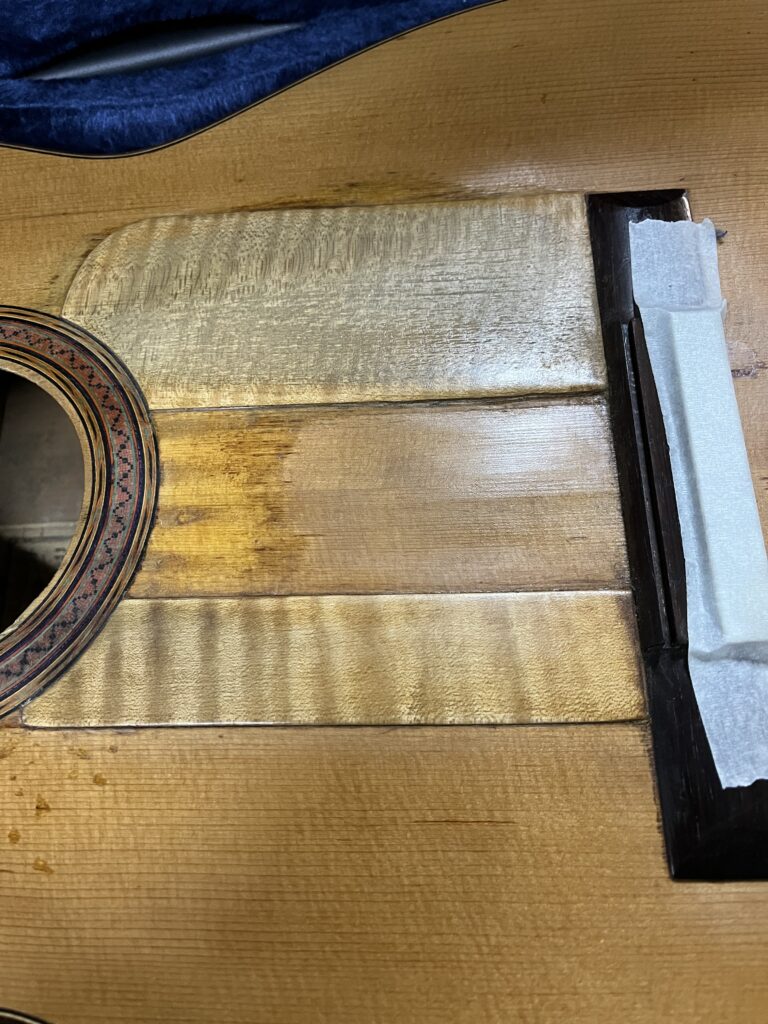
Inside the body were numerous fabric reinforcements attached with hide glue. This method had been used to consolidate the joints, but the accumulated layers were affecting the way the body worked acoustically.
I removed these later additions and retained the original components wherever possible.
Some internal reinforcements were missing and had to be replaced. I used old wood and gave the new components a light patina before fitting them, so that they would not stand out unnecessarily inside the instrument.
Missing material was reinstated only where there was clear evidence that an earlier component had existed.
Restoring the multi-piece sides and back
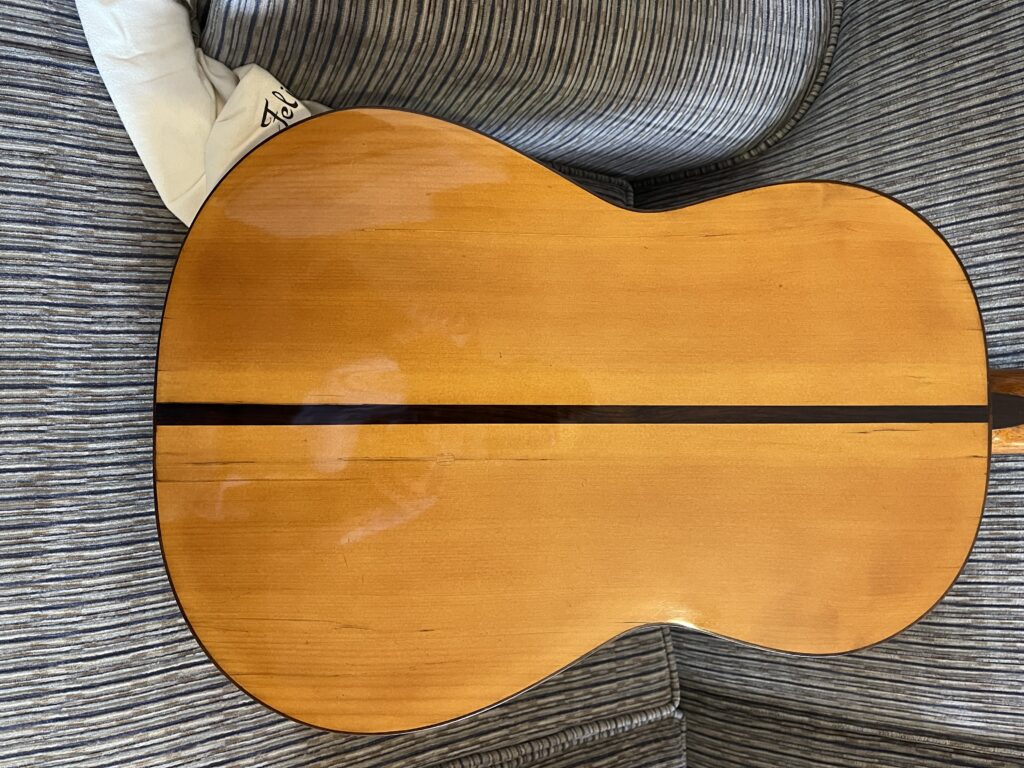
The sides are made from two pieces joined lengthwise by a decorative strip. The back is also assembled from several sections.
These solutions may seem unusual today, but access to suitable timber was very different in 1856. Makers could not simply select a complete set in the required dimensions.
They worked with the material available and reused pieces left over from other joinery and cabinetmaking work.
In this case, that limitation resulted in a guitar with a highly distinctive construction, in which the decorative work integrates the separate pieces into the overall design of the instrument.
The internal joints retained a rigid strip, rather like card, which had deteriorated badly over time. I removed it and prepared a small wood-veneer laminate: one layer following the grain and another running across it to stabilise the joint.
From inside the guitar, the grain still reads longitudinally, while the reinforcement itself functions structurally as a laminate.
Purpleheart back and sides?
The soundboard is spruce. As for the back and sides, I believe they may be made of purpleheart, although I cannot identify the species with complete certainty.
Most of the wood had changed colour through oxidation and age. Beneath the label and in a few protected areas, however, a violet tone remained that strongly suggested this species.
The sides were approximately 1.2 to 1.3 millimetres thick. They were extremely thin, leaving no margin for sanding or cleaning beyond what was strictly necessary.
The tentative identification as purpleheart is based on those areas where the wood retained more of its original colour.
Reconstructing the purfling and restoring the finish
Once the body had been reassembled, the guitar was finished with shellac. In this case, virtually no trace of the original finish remained that could be preserved: the collapse and earlier restorations had made it necessary to treat the instrument as a whole.
Four months restoring a historic Spanish guitar
The guitar remained in the workshop for approximately four months.
This was not work that could be carried out continuously. One area had to be cleaned and glued, then left until the following day before work could begin on the next joint.
Almost every joint required attention. The pace was dictated by the hide glue, drying time, and the need to avoid forcing components that had been part of the instrument for more than 150 years.
Once the body was reassembled, I refitted the fingerboard and bridge. The guitar recovered much of its original structure and displayed very good intonation.
The result was an instrument with a sweet sound and a character close to that of the Romantic guitar, although its outline was already approaching that of the modern Spanish guitar.
The guitar is reunited with its owner
After four months of work, the guitar returned to its owner. The moment he opens the case conveys the significance of recovering an instrument that had appeared to be lost.
The instrument is returned after its complete reconstruction.
Specifications of the 1856 Pablo del Hierro guitar
The label places Pablo del Hierro in Tortosa, although very little is known about the guitar maker.
- Guitar maker
- Pablo del Hierro
- Year
- 1856
- Location stated on label
- Tortosa
- Soundboard
- Spruce
- Back and sides
- Possibly purpleheart
- Scale length
- 640 mm
- Fingerboard
- Ebony
- Finish
- Shellac
- Body depth
- Approximately 11 cm at the tail block
- Body construction
- Two-piece sides and a back assembled from several sections
Only two known guitars by this maker survive, both owned by the same Argentine collector.
The Pablo del Hierro guitar sounds again
After the restoration, the guitar returned to its owner. These recordings reveal its sweet, balanced voice, consistent with the period and proportions of the instrument.
Performed on the 1856 Pablo del Hierro guitar after restoration.
A second performance revealing the character of the restored guitar.
This restoration required the complete disassembly of a guitar whose joints had almost entirely failed, even though very few components had actually broken.
Humidity had softened the glue, and string tension had deformed the entire body. The work involved recovering each component, removing later additions, reinstating missing material, and reassembling the instrument with as much original material as possible.
After four months, the guitar recovered its shape, its intonation, and its ability to sound once again.
Domingo Esteso 1924: Cracks, Cypress and a Side Fitted Backwards
José Ramírez 1933: The Guitar Hidden Beneath a Layer of Black Paint
Manuel Ramírez 1915: Birdseye Maple and New Brass Frets
Marcelo Barbero 1949: Saving a Soundboard Just 0.5 Millimetres Thick
Marcelo Barbero 1945: Restoring a Guitar That Had Come Apart Inside
Santos Hernández 1933: Repairing the Sides from Inside the Guitar
Santos Hernández, 1924: Opening a Spanish Guitar After One Hundred Years