Workshop journal
The restoration of a 1924 Domingo Esteso flamenco guitar: closing cracks in the back and soundboard without stiffening its lightweight cypress structure.
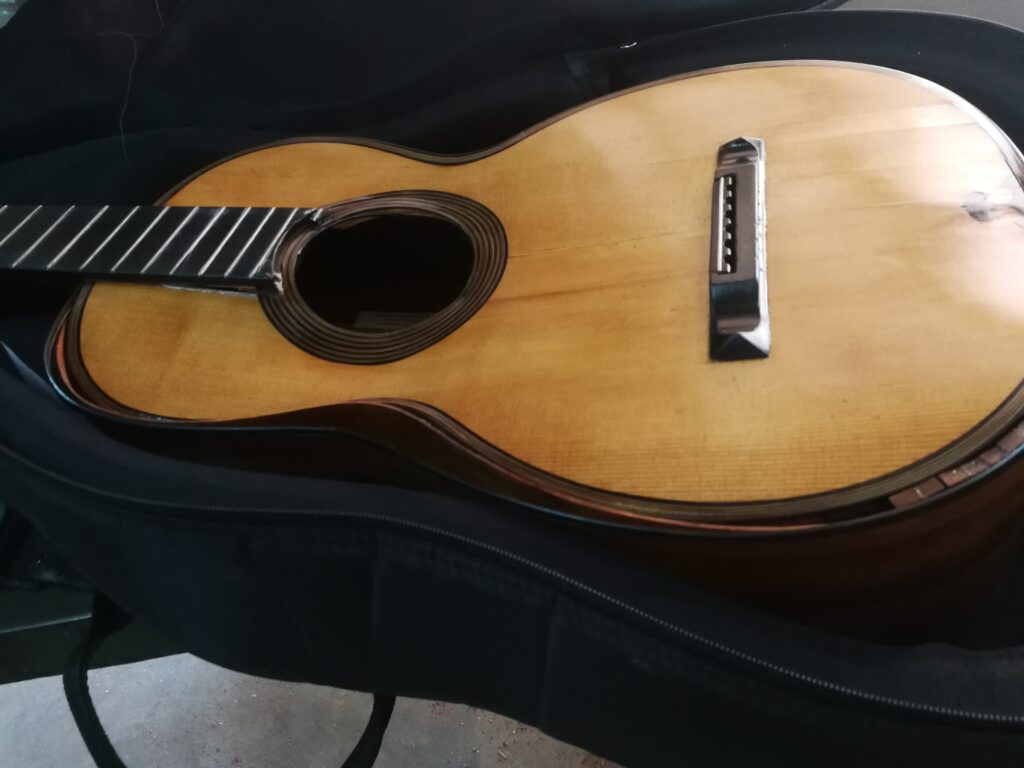
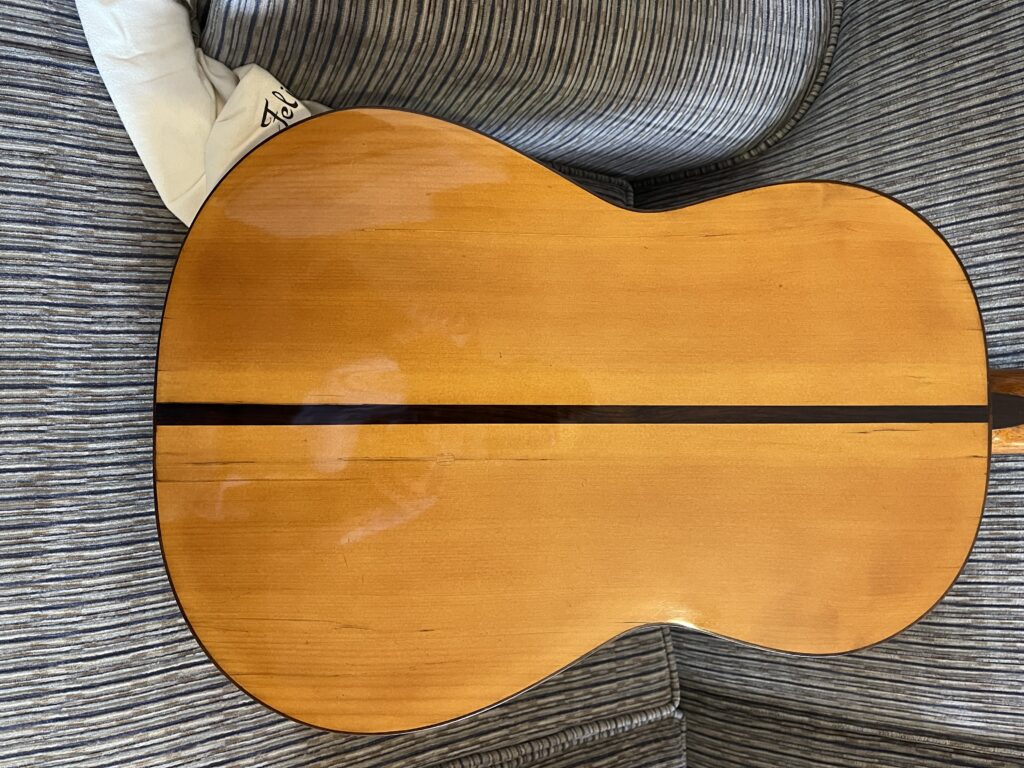
This 1924 Domingo Esteso arrived at the workshop with two longitudinal cracks in the back and another small opening in the central area of the soundboard.
The guitar’s overall structure was well preserved. There was no need to open it completely or replace any major component. The work consisted of closing the cracks, reinforcing them from inside and maintaining the lightness of a cypress flamenco guitar approaching its hundredth year.
The examination also revealed a highly visible construction detail: one of the sides is fitted in reverse. Both sides had been bent in the same direction, and one was ultimately assembled with its grain orientation reversed.
Who knows what happened in Domingo Esteso’s workshop that day.
Closing the cracks without stiffening the guitar
The back had two cracks running along the grain. The soundboard had another small crack in its central area.
The instrument may at some point have been exposed to unfavourable humidity conditions. In such a lightweight body, dimensional changes in the wood eventually become visible wherever accumulated tension finds the least resistance.
I closed the cracks and fitted the necessary internal reinforcements. In this type of restoration, I try not to add more material than is essential. It would make no sense to repair a cypress flamenco guitar from this period only to stiffen a structure that has worked successfully for a hundred years.
The repair must restore continuity to the wood while also respecting how the body functions.
Cracks in the cypress back and spruce soundboard during restoration.
A cypress side bent in the wrong direction
The reversed side is one of those details that immediately draws attention when looking at the guitar.
Both sides were bent in the same direction and, when the body was assembled, one ended up with the opposite orientation. Logically, each piece would have been prepared for its intended position, but for some reason that did not happen.
Today we tend to view such decisions through the possibilities of a modern workshop. We have electric machinery, thickness sanders, moulds, bending machines and prepared wood with which to start again if a piece does not turn out as intended.
In 1924, this was not the case.
Cutting out a side, thicknessing, planing and bending it could take an entire working day. Perhaps Domingo Esteso noticed too late. Perhaps he had no other suitable piece of cypress available. Perhaps he needed to finish that guitar and decided to use the side.
We cannot know.
What is certain is that the piece was fitted in this way and has remained there for a century. Its grain orientation breaks the visual continuity we would expect between the two sides, but it does not appear to have caused any significant structural consequence.
The cracks I repaired were in the back and soundboard. The reversed side had aged well.
The different grain orientation of the two cypress sides.
A cypress flamenco guitar after one hundred years
The guitar is built with a German spruce soundboard and cypress back and sides.
It weighs only 1,170 grams, confirming the lightness of the instrument. There is no excess wood or oversized structure. It is a flamenco guitar built within a tradition in which cypress, wooden friction pegs and careful weight control form part of a single conception of the instrument.
The cypress has aged to a warmer colour and developed its own patina. It did not need to regain the appearance of new wood or have the traces of time erased. The restoration had to stabilise the guitar without removing what it had acquired during its life.
This balance is important in any historic Spanish guitar. Closing a crack is one thing; refinishing a surface until all the information it preserves has disappeared is something quite different.
This Domingo Esteso did not arrive at the workshop as an archaeological object. It arrived as a flamenco guitar that could continue to be used and whose principal problem was clearly localised.
Specifications of the 1924 Domingo Esteso guitar
This Spanish guitar has a German spruce soundboard, cypress back and sides and a scale length of 655 millimetres.
The nut is 52 millimetres wide. The spacing between the first and sixth strings is 43 millimetres at the nut and 58 millimetres at the saddle.
The string height at the 12th fret is 2.6 millimetres, and the height above the soundboard at the saddle is 10.1 millimetres.
It retains traditional wooden friction pegs, has a French-polished shellac finish and weighs 1,170 grams.
These measurements are characteristic of a lightweight flamenco guitar, with low action and sufficient string height above the soundboard.
- Maker and year
- Domingo Esteso, 1924
- Type
- Flamenco guitar
- Soundboard
- German spruce
- Back and sides
- Cypress
- Scale length
- 655 mm
- Nut
- 52 mm wide; 43 mm between the first and sixth strings
- Saddle
- 58 mm between the first and sixth strings
- String heights
- 2.6 mm at the 12th fret; 10.1 mm above the soundboard at the saddle
- Tuners
- Traditional wooden friction pegs
- Finish
- French-polished shellac
- Weight
- 1,170 g
Pedro Javier González plays the 1924 Domingo Esteso
After the restoration, the guitar was recorded by Pedro Javier González.
The video shows the instrument after stabilisation and captures its response after the cracks in the back and soundboard were closed.
This was a focused restoration: closing the cracks, reinforcing the affected areas and preserving the guitar’s original structure.
After one hundred years, it remains an instrument ready to make music.
José Ramírez 1933: The Guitar Hidden Beneath a Layer of Black Paint
Manuel Ramírez 1915: Birdseye Maple and New Brass Frets
Marcelo Barbero 1949: Saving a Soundboard Just 0.5 Millimetres Thick
Marcelo Barbero 1945: Restoring a Guitar That Had Come Apart Inside
Santos Hernández 1933: Repairing the Sides from Inside the Guitar
Santos Hernández, 1924: Opening a Spanish Guitar After One Hundred Years
Pablo del Hierro 1856: Rebuilding a Spanish Guitar Piece by Piece