Workshop Journal
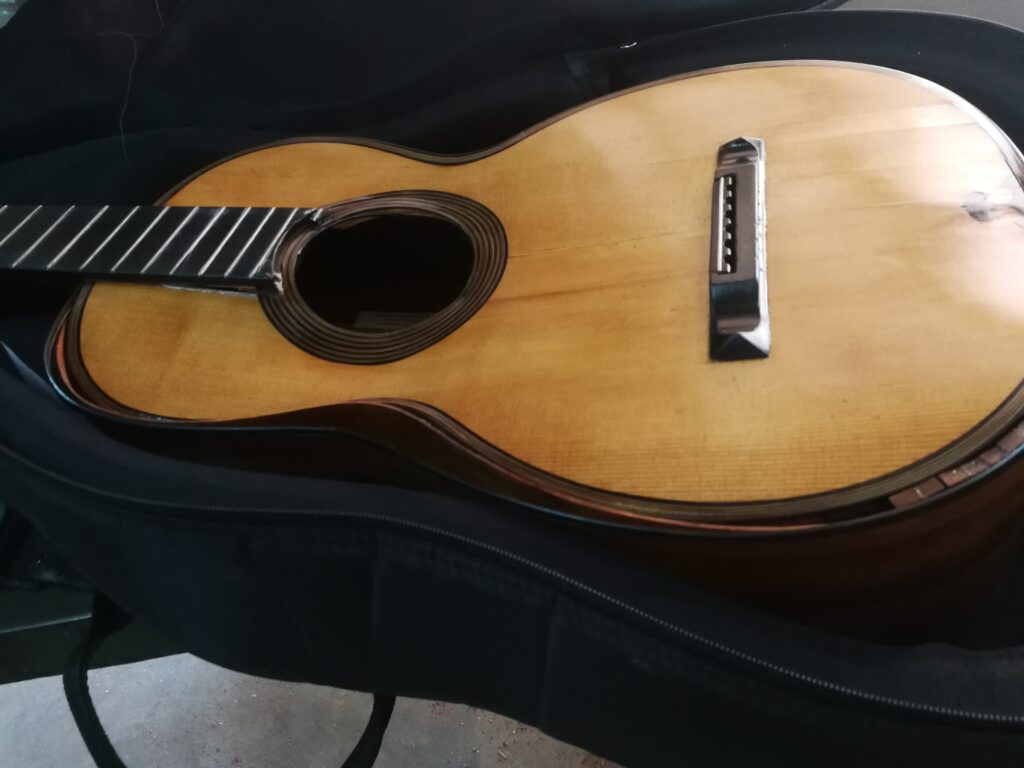
This 1924 Santos Hernández arrived at the workshop with a severely weakened structure and several earlier repairs that did not respect the guitar’s original construction.
The back braces had come loose, one of the soundboard braces had shifted out of position and pushed one of the sides outward.
There was also a major break in the lower part of the side, sections of the bindings and purflings were missing, and several lining blocks had been added around the damaged area with white glue.
To carry out the restoration properly, I had to remove the back and inspect the entire internal structure.
Structural restoration of a 1924 Santos Hernández guitar
The soundboard brace had been out of position for a long time. As it shifted, it deformed the side, and the very dry wood had eventually settled into that shape.
It took an enormous amount of work to bring it back into position.
It could not be corrected in a single operation, nor could the wood simply be forced back. I gradually recovered the original curve until the side could be joined to the soundboard again.
The impact to the lower bout had broken the purfling, opened the joint and loosened several lining blocks. Before repairing the area, I removed the later additions, closed the break and replaced only the lining blocks that were missing.
Recovering the original side and braces of the Santos Hernández guitar
The back braces were also loose and had excessive play. I fitted them one by one and glued them back into place.
The original braces were retained. There was no reason to replace them when they could still recover their structural function.
The guiding principle was to preserve the original structure wherever the material remained sound, limiting replacement to parts that had genuinely been lost.
Opening and closing a historic Spanish guitar
I removed the back while preserving the external bindings and purflings. With the body open, I could access the braces, correct the seating of the soundboard brace and work on the internal joints.
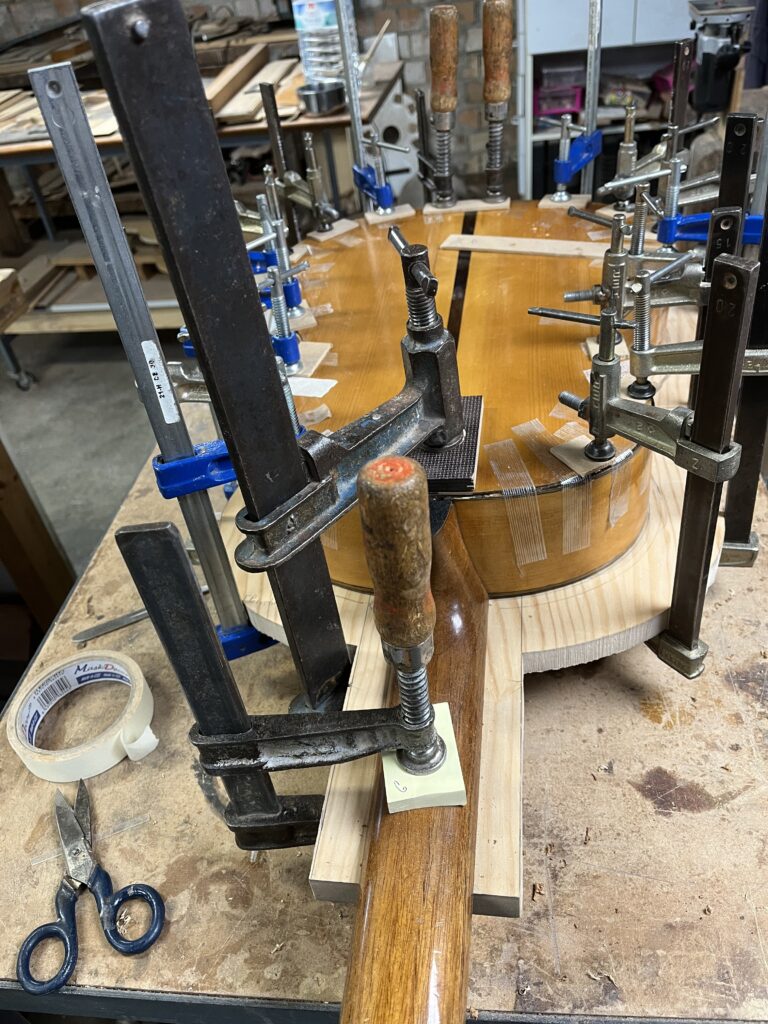
After completing the repairs, I closed the back again using hot hide glue.
This type of adhesive requires careful preparation. It must be kept at the correct temperature, the pressure applied properly, and the parts positioned before the glue loses its working properties.
The following video brings together footage of the guitar opened for restoration, the correction of the side, the fitting of the braces and the closing of the body, together with a sound test by Juan Antonio Moya at Solera Flamenca.
Restoration of the 1924 Santos Hernández guitar and sound test by Juan Antonio Moya at Solera Flamenca.
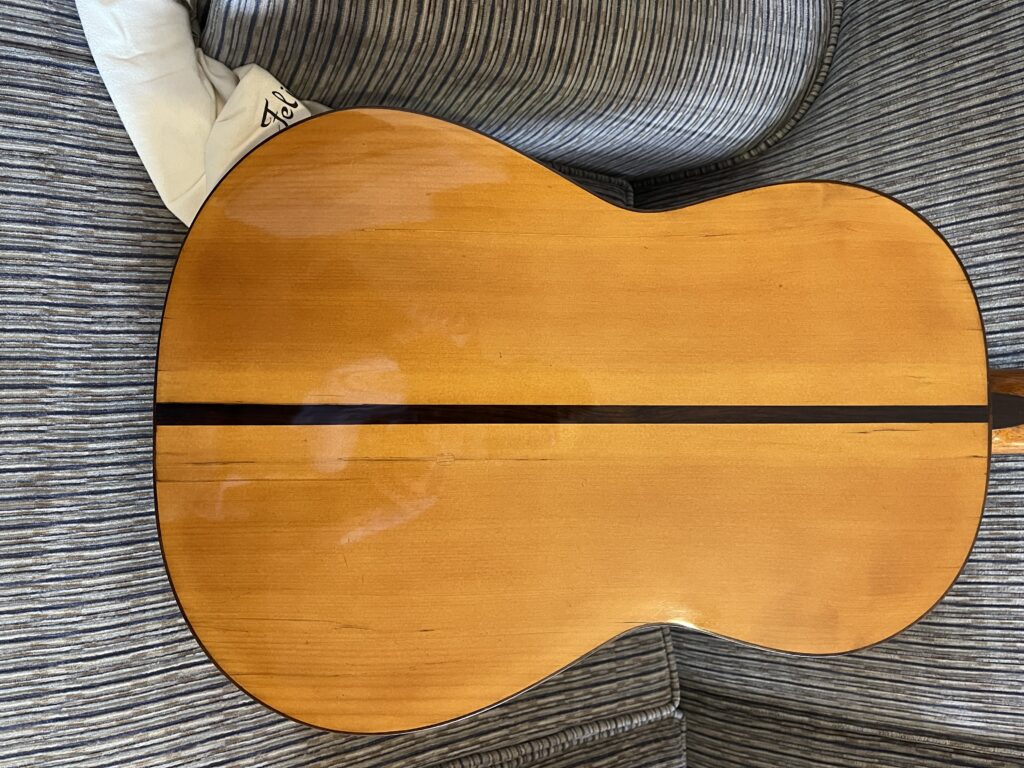
A four-piece Baltic pine soundboard
When examining the interior, I found that the soundboard had been made from four pieces of pine.
From the outside, the joints are barely visible. The grain is so continuous that the four pieces may have come from the same block, although I cannot confirm this.
The joints are reinforced internally with small cross-grain wooden cleats. These very thin pieces are original to the construction, and they make it possible to identify clearly the four sections that form the soundboard.
It is extremely well executed. Even when you know where the joints are, they remain difficult to locate from the outside.
Today there is a great deal of discussion about German spruce, but in 1924 this was Baltic pine—the kind of pine used by cabinetmakers. Access to materials was inconsistent, and makers worked with the wood available to them, using it in a very different way.
This four-piece soundboard is neither an improvised nor an inferior solution: the joints are exceptionally well made and have survived for a full century.
Brazilian rosewood back and sides
The back and sides are made from Brazilian rosewood.
It is a very dense timber; some specimens approach 1,000 kilograms per cubic metre. In this guitar it contributes to a dry, deep response, with strongly defined basses and a serious character.
That does not mean Brazilian rosewood is inherently better than other woods. Each species contributes a different response, and the result depends on the guitar as a whole, not only on the value or rarity of the material.
Despite the density of the rosewood, this Santos Hernández weighs 1,330 grams. It remains a very lightly built Spanish guitar.
Specifications of the 1924 Santos Hernández guitar
The guitar has a four-piece Baltic pine soundboard, Brazilian rosewood back and sides, and a 650 mm scale length.
- Maker
- Santos Hernández
- Year
- 1924
- Soundboard
- Four-piece Baltic pine
- Back and sides
- Brazilian rosewood
- Scale length
- 650 mm
- Nut width
- 52 mm
- String spacing at the nut
- 42 mm
- String spacing at the saddle
- 58 mm
- Action at the 12th fret
- 2.9 mm
- String height above the soundboard at the saddle
- 10.3 mm
- Tuning machines
- Machine heads
- Finish
- French-polished shellac
- Weight
- 1,330 g
Xavier Coll plays the 1924 Santos Hernández guitar
The guitar can also be heard in a recording by Xavier Coll published by Solera Flamenca.
Sound test of the guitar after restoration, published by Solera Flamenca.
When this Santos Hernández arrived at the workshop, it had loose braces, a deformed side and a break that had undergone several later repairs.
The original structure, however, remained almost entirely intact. I opened the guitar, removed the later additions, retained the original braces and returned the side to its proper position.
The interior also revealed an exceptionally well-executed four-piece soundboard: a construction method that is barely visible from the outside and remains fully functional a century later.
Domingo Esteso 1924: Cracks, Cypress and a Side Fitted Backwards
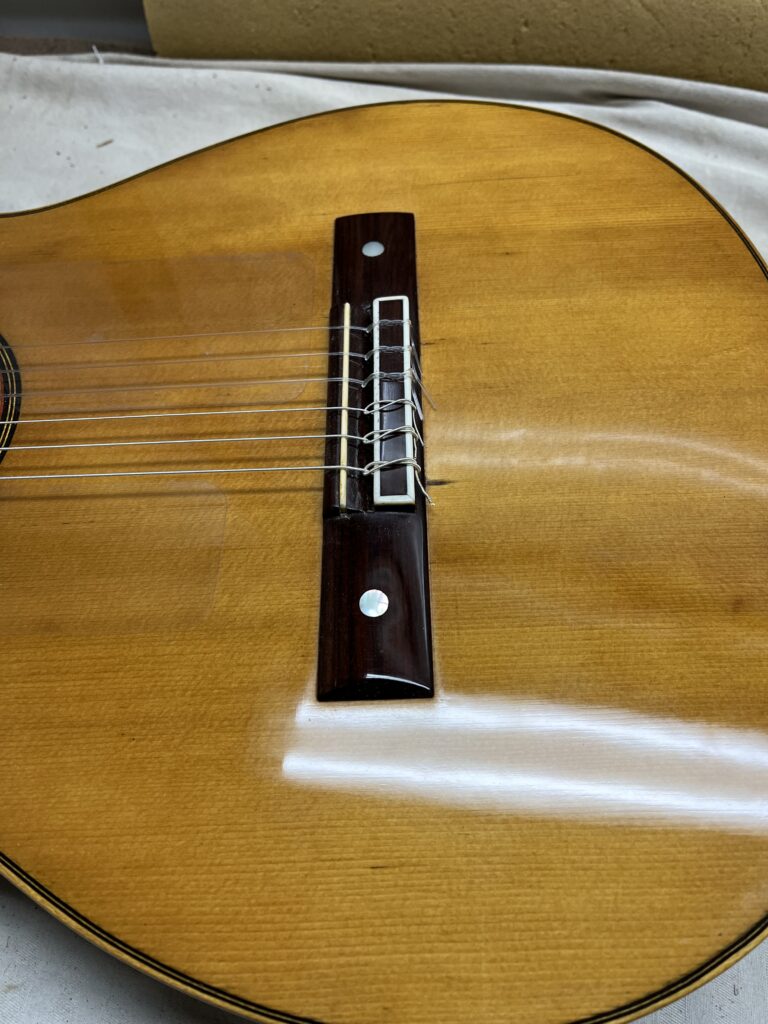
José Ramírez 1933: The Guitar Hidden Beneath a Layer of Black Paint
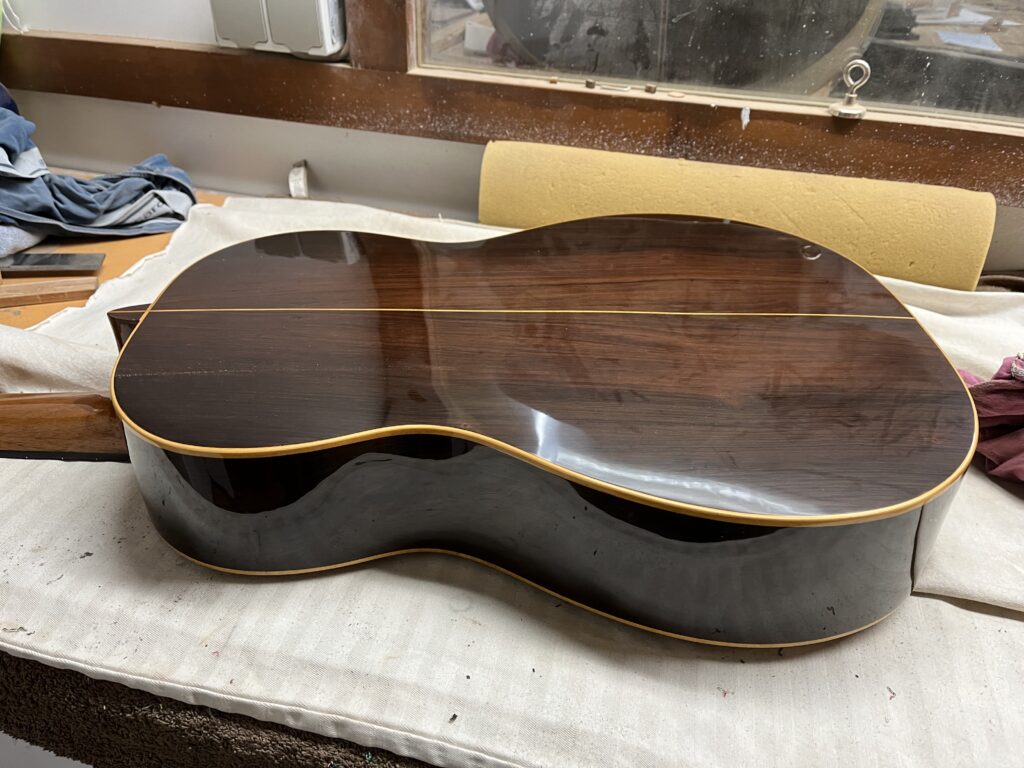
Manuel Ramírez 1915: Birdseye Maple and New Brass Frets
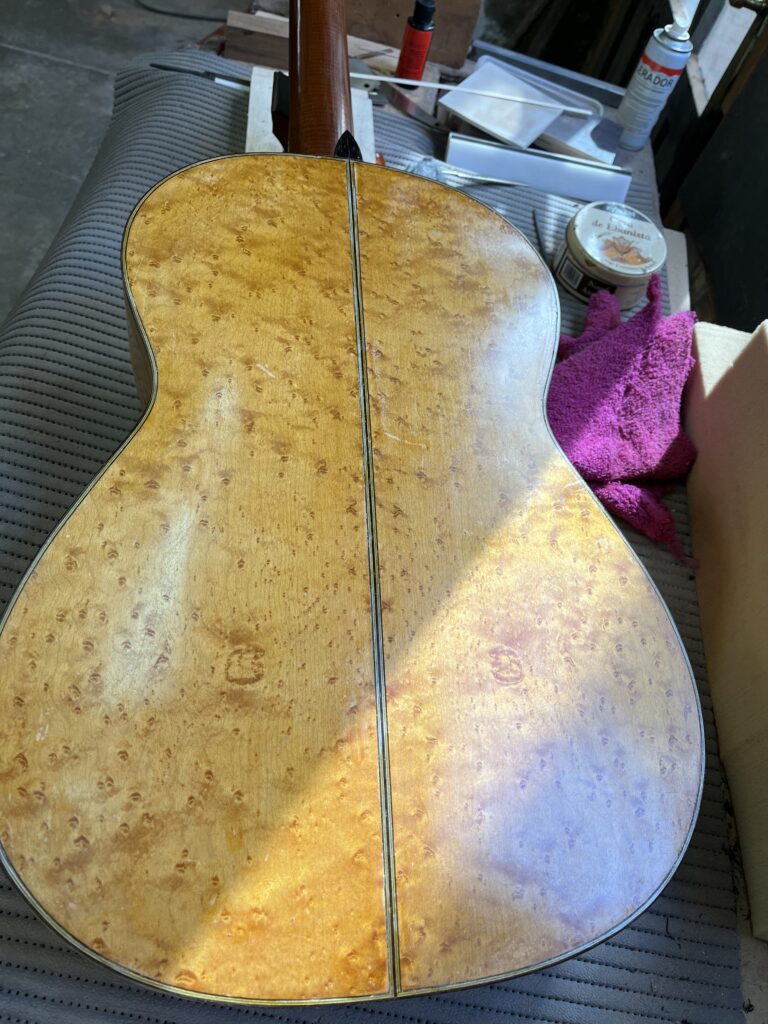
Marcelo Barbero 1949: Saving a Soundboard Just 0.5 Millimetres Thick
Marcelo Barbero 1945: Restoring a Guitar That Had Come Apart Inside
Santos Hernández 1933: Repairing the Sides from Inside the Guitar
Pablo del Hierro 1856: Rebuilding a Spanish Guitar Piece by Piece