Workshop journal
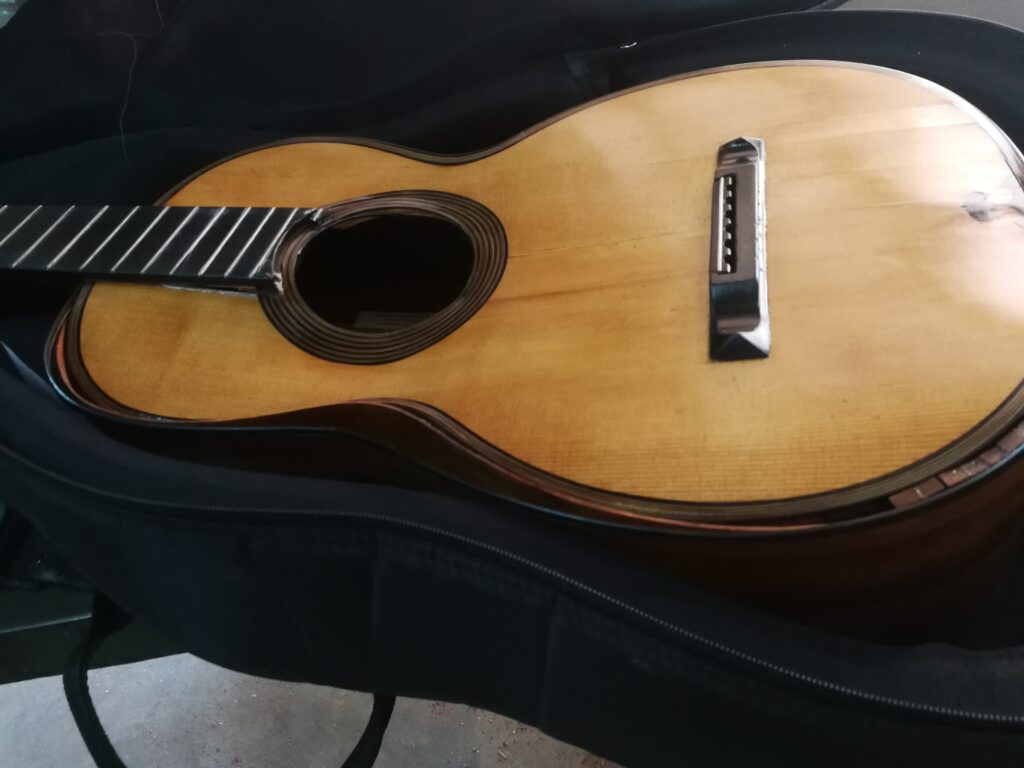
A structural restoration to close soundboard cracks and reglue the sides to the end block of this historic flamenco guitar.
This 1933 Santos Hernández arrived at the workshop with several cracks in the soundboard and both sides detached from the end block.
The joint had not opened completely. The block remained glued to the soundboard and back, but the sides had separated and needed to be returned to their correct position before being reglued.
The challenge was how to apply pressure from inside a closed guitar. To solve it, I devised a system using a bandurria string and machine head.
Regluing the sides to the guitar’s end block
A small wooden strip covered the internal joint between the sides. I removed it so that I could pass a bandurria string through the joint and attach it to small metal pieces positioned inside the body.
I brought the string outside the guitar and connected it to a bandurria machine head. Turning the tuner drew the metal pieces towards the tail of the guitar, pressing both sides against the end block.
The joints between the sides and the block, and between the sides and the soundboard, had to be restored simultaneously. The system made it possible to control the pressure and direct it precisely towards the area that needed to close.
Once the glue had dried, I removed the string and metal pieces and replaced the internal wooden strip over the joint.
Custom pressure system devised to restore the joint between the sides and the end block.
A custom tool for a specific guitar repair
This type of work often requires the tool to be made during the restoration itself.
There was no way to place a conventional clamp inside the body or to press the sides correctly from the outside. The bandurria string and machine head converted external tension into pressure against the end block.
This solution was devised for this guitar and this particular area of its structure. In another restoration, the available access or the required direction of pressure might call for a completely different system.
Repairing the cracks in the soundboard
The soundboard also had several cracks, which I closed and stabilised during the restoration.
In this case, there was no need to open the guitar or add larger reinforcements. The work was limited to restoring the continuity of the wood and reinforcing the areas that required it.
After the cracks were closed and the sides reglued, the body regained its structural stability.
Closing and stabilising the soundboard cracks, together with the maker’s signature preserved inside the guitar.
Original flamed-maple tap plates
This Santos Hernández retains its two original flamed-maple tap plates.
Some historic Spanish guitars have wooden tap plates, dating from before plastic materials came into widespread use. Wood requires greater thickness and adds more mass to the soundboard, but on this guitar the two plates are part of its original construction.
Both tap plates were preserved during the restoration.
The two flamed-maple tap plates are part of the guitar’s original construction.
Specifications of the 1933 Santos Hernández guitar
This flamenco guitar has a spruce soundboard, cypress back and sides, and an ebony fingerboard. The bindings appear to be made from Brazilian rosewood.
It has a 660 mm scale length and a nut width of 51 mm. The spacing between the first and sixth strings is 42 mm at the nut and 58 mm at the saddle.
After adjustment, the string height measured 2.6 mm at the 12th fret and 9.6 mm above the soundboard at the saddle.
It retains traditional wooden friction pegs, has a French-polished shellac finish and weighs 1,230 grams.
- Maker and year
- Santos Hernández, 1933
- Type
- Flamenco guitar
- Soundboard
- Spruce
- Back and sides
- Cypress
- Fingerboard
- Ebony
- Bindings
- Probably Brazilian rosewood
- Scale length
- 660 mm
- Nut
- 51 mm wide; 42 mm between the first and sixth strings
- Saddle
- 58 mm between the first and sixth strings
- String heights
- 2.6 mm at the 12th fret; 9.6 mm above the soundboard at the saddle
- Tuners
- Traditional wooden friction pegs
- Finish
- French-polished shellac
- Weight
- 1,230 g
The restored guitar is played in the workshop
After the restoration, a guitarist played the Santos Hernández in my workshop.
The recording captures the instrument after the cracks were closed and the joint between the sides and the end block was restored.
José Andrés Cortés plays the 1933 Santos Hernández guitar
The guitar can also be heard in two recordings by José Andrés Cortés published by Solera Flamenca.
In this restoration, the principal challenge was not identifying which parts were loose, but finding a way to clamp them from inside the closed body.
The bandurria string-and-tuner system brought the sides back against the block, held them in position while the glue dried, and allowed the entire mechanism to be removed afterwards without leaving anything inside the guitar.
A simple solution for restoring a joint that was difficult to reach.
Domingo Esteso 1924: Cracks, Cypress and a Side Fitted Backwards
José Ramírez 1933: The Guitar Hidden Beneath a Layer of Black Paint
Manuel Ramírez 1915: Birdseye Maple and New Brass Frets
Marcelo Barbero 1949: Saving a Soundboard Just 0.5 Millimetres Thick
Marcelo Barbero 1945: Restoring a Guitar That Had Come Apart Inside
Santos Hernández, 1924: Opening a Spanish Guitar After One Hundred Years
Pablo del Hierro 1856: Rebuilding a Spanish Guitar Piece by Piece