Workshop journal
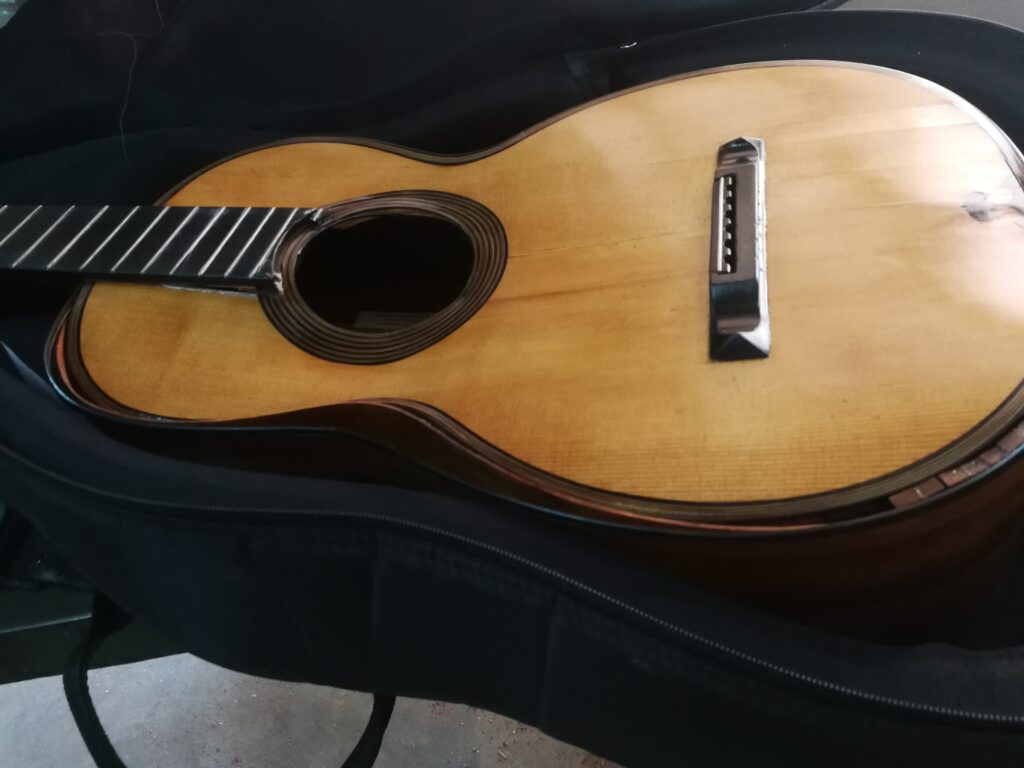
The restoration of a 1949 Marcelo Barbero flamenco guitar whose soundboard had been reduced to just 0.5 millimetres in one area.
This 1949 Marcelo Barbero had undergone several repairs before arriving at my workshop.
The back was open, there was a break beside one of the soundboard fan braces, a crack in the back and several internal reinforcements added during previous interventions.
The most delicate problem, however, was in the soundboard. After being sanded several times, its lower section had been reduced to a thickness of barely 0.5 millimetres.
It was like paper. You could practically break it just by touching it.
The challenge was to restore some consistency without replacing the soundboard or adding a structure that would alter more than necessary a guitar that had already endured too many interventions.
Restoring a soundboard reduced to half a millimetre
At half a millimetre thick, that area of the soundboard had lost almost all its rigidity.
This was not only a problem for the guitar’s future performance. The restoration itself had to be carried out with great care, because the wood could withstand almost no pressure and might break while I worked on it.
I studied the possibilities and discussed them with the owner. We ultimately made the decision together: disturb as little as possible while giving the area slightly more consistency.
I prepared a very thin wood veneer and fitted it internally with its grain running across that of the soundboard. This added stability to the weakened area without introducing excessive thickness or weight.
The intention was not to cover the entire soundboard or turn it into a different structure. The reinforcement had to remain confined to the section reduced by previous sanding.
Previous repairs and the lightweight reinforcement of the soundboard area reduced to half a millimetre.
Removing the back to work from inside the guitar
The back had to be removed to gain access to the structure.
Opening the guitar revealed various reinforcements installed during earlier restorations. Some were poorly executed and had to be removed before the damaged areas could be repaired correctly.
There was also an opening beside one of the soundboard fan braces. I closed and stabilised the wood while preserving both the brace and the original soundboard.
The back had another crack, which was also repaired before the body was closed again.
Once the internal work was complete, I refitted the back while preserving its original bindings and purflings.
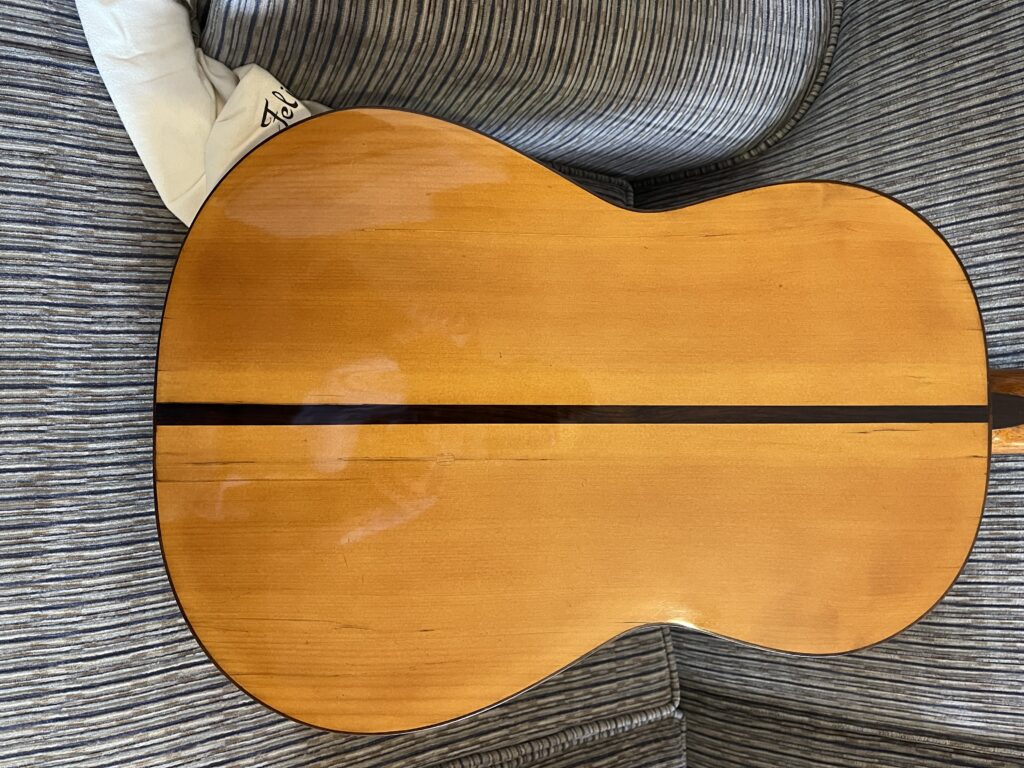
Repairing the crack in the cypress back and closing the body with its original bindings and purflings.
Reconstructing the decorative end strip
There was a hole in the lower end of the guitar, probably made to install a microphone or amplification system.
The hole passed through one of the decorative strips on the back. It was not possible to close the opening while retaining that part of the ornament as it was.
I removed the complete strip, repaired the hole and made a new piece reproducing the original design.
I removed the entire ornament, closed the small hole and fitted a new one made to match the original.
The replacement had to restore the continuity of the back and blend with the rest of the decoration, without leaving that later modification visible.
Repairing the hole and reconstructing the decorative strip at the tail of the guitar.
Preserving the guitar’s patina
Although I had to open the guitar and carry out extensive work inside, there was no need to refinish the entire instrument.
I worked only on the affected areas of the bindings and purflings and on the new piece at the tail. I applied shellac with a small brush, gradually adjusting the finish until it blended with the existing surface.
With a Spanish guitar of this age, I do not want repaired areas to look newly made. The finish, wear and subtle variations in colour are part of the condition in which the instrument has reached us.
The restoration had to become part of that patina, not replace it.
A lightweight Marcelo Barbero flamenco guitar
This guitar has a spruce soundboard and cypress back and sides.
It is a very lightweight flamenco guitar, weighing 1,260 grams despite its accumulated repairs and the reinforcement that had to be added beneath the soundboard.
The intervention required a delicate balance. The area reduced to half a millimetre needed a minimum degree of rigidity, but the body could not be burdened with an excessive structure.
This is why I used a thin, cross-grain veneer. It provided strength with the smallest possible amount of material.
The original soundboard remained in the guitar. It was neither replaced nor stripped of the history of interventions it retained.
Specifications of the 1949 Marcelo Barbero
This Spanish guitar has a spruce soundboard, cypress back and sides and a scale length of 660 millimetres.
The nut is 52 millimetres wide. The spacing between the first and sixth strings is 43 millimetres at the nut and 56 millimetres at the saddle.
After adjustment, the string height measured 2.4 millimetres at the 12th fret and 8.4 millimetres above the soundboard at the saddle.
It has geared machine heads, a French-polished shellac finish and weighs 1,260 grams.
- Maker and year
- Marcelo Barbero, 1949
- Type
- Flamenco guitar
- Soundboard
- Spruce
- Back and sides
- Cypress
- Scale length
- 660 mm
- Nut
- 52 mm wide; 43 mm between the first and sixth strings
- Saddle
- 56 mm between the first and sixth strings
- String heights
- 2.4 mm at the 12th fret; 8.4 mm above the soundboard at the saddle
- Machine heads
- Geared
- Finish
- French-polished shellac
- Weight
- 1,260 g
Sound tests in the workshop
After the restoration, two guitarists played the Marcelo Barbero in the workshop.
These recordings capture the guitar in the same space where the restoration was carried out, after the soundboard was reinforced, the cracks closed and the back refitted.
Alberto Fernández plays the 1949 Marcelo Barbero
The guitar can also be heard in a recording by Alberto Fernández.
The video shows the instrument after restoration and captures the final result of the work on this cypress flamenco guitar built in 1949.
This Marcelo Barbero arrived at the workshop with several previous repairs, a hole in the tail and part of its soundboard reduced to half a millimetre.
I did not want to replace the soundboard or cover it with a heavy reinforcement. I added a thin cross-grain veneer only to the area that needed to regain consistency.
I then repaired the cracks, removed additions that were not functioning correctly, reconstructed the decorative strip crossed by the hole and closed the body again while preserving the instrument’s bindings, purflings and patina.
In this case, restoration meant working on a guitar that had already been altered too many times and ensuring that this new intervention was the minimum necessary.
Domingo Esteso 1924: Cracks, Cypress and a Side Fitted Backwards
José Ramírez 1933: The Guitar Hidden Beneath a Layer of Black Paint
Manuel Ramírez 1915: Birdseye Maple and New Brass Frets
Marcelo Barbero 1945: Restoring a Guitar That Had Come Apart Inside
Santos Hernández 1933: Repairing the Sides from Inside the Guitar
Santos Hernández, 1924: Opening a Spanish Guitar After One Hundred Years
Pablo del Hierro 1856: Rebuilding a Spanish Guitar Piece by Piece